
This manual is designed to help trainers in conducting workshops for religious leaders and women leaders of faith on gender-based violence and HIV. Training is organized into four sessions and includes instruction for various activities to be included as part of the training. It is structured as a three day session. The objective of the training is to raise the awareness of religious leaders and women leaders of faith regarding gender-based…
Content Type
FOUND 1377
Based on the most recent data from 182 countries, this publication highlights global epidemiological trends and provides an update on the AIDS epidemic and response. It includes new country scorecards on key issues facing the AIDS response as well as trend data on incidence from more than 60 countries. Furthermore, the report provides a synopsis of achievements, failures and obstacles in achieving universal access to HIV prevention, treatment,…
This publication highlights key 2009 interagency initiatives, all of which operate at the intersection of gender equality, women’s empowerment and HIV. Initiatives profiled include Universal Access for Women and Girls Now!, UNAIDS Programme Acceleration Funds, and Enhancing Regional technical capacity on gender and HIV, a UNDP-led project. The publication also provides a regional and country analysis of activities and projects implemented in…
Launched in Geneva ahead of the XVIII International AIDS Conference in Vienna, this publication outlines a radically simplified HIV Treatment platform that could decrease the number of AIDS-related death drastically and could also greatly reduce the number of new HIV infections. The report provides new UNAIDS and Zogby International public opinion polls which show, that nearly 30 years into the AIDS epidemic, countries continue to rank AIDS high…
This publication is the third volume of the USAID Health Policy Initiative’s “Investing in MENA Series.” The purpose of the curriculum is to support a sustainable HIV response in the Middle East and North Africa (MENA) Region, centered on positive leadership, women’s leadership, prevention, education, and mentorship, as well as gender equality and sensitivity. Structured as a three-day workshop, it is the first curriculum of its kinds to be…
This report is a synthesis of the key insights, questions, challenges and recommendations that emerged from a meeting held to explore emerging insights into the linkages between economic empowerment and HIV outcomes for girls and your women. It addresses two key questions: 1) What are the links between economic status and HIV vulnerability of girls and young women? and 2) What is the role of economic empowerment in preventing and mitigating HIV…
This report outlines a methodology for integrating gender into the Policy Implementation Barriers Analysis (PIBA) activity which was designed to pilot a methodology and set of tools to identify key barriers to implementing programs under the President's Emergency Plan for AIDS Relief (PEPFAR). The project integrated gender into the PIBA activity to help underscore the various needs of women and men within the context of barriers to…
This report highlights the critical importance of ensuring that gender equality and women’s empowerment are central to the aid effectiveness agenda and attempts to identify the extent to which HIV funding is contributing to an environment that supports gender equality and promotes women’s rights. It includes an assessment of the effectiveness of current aid flows in combating inequality and violations of women’s rights that have contributed the…
This publication represents an initial effort to draw attention to the knowledge, institutional capacity, and resources needed to comprehensively address the intersection between HIV and AIDS and Violence Against Women and Girls (VAWG). It profiles ten organizations that are working on innovative strategies to address the intersection between violence against women and HIV/AIDS, and highlights key elements to consider in the implementation of…
This publication provides a descriptive analysis of how adolescent girls and young women construct notions of risk and safety within the context of HIV/AIDS, and what strategies they develop to protect themselves. The study is based on data from interviews held with 821 young women aged from 15-24 from four communities of urban Lusaka, and supplemented by qualitative data from focus group discussions and in-depth interviews. Information from…
This publication is the third report produced by the Women Won’t Wait Campaign aimed at holding institutions accountable for turning policy rhetoric into practice in response to the intersecting crisis of HIV and violence against women and girls. This publication analyses the policies, programming, and funding patterns of five agencies: UNAIDS, the Global Fund to Fight AIDS, Tuberculosis, and Malaria, the World Bank, the US Government’s…
Bar girls have become a rising concern for those looking to stem the spread of HIV, says a recent study conducted by KEM Hospital’s preventive medicine department. Read full article here.
SENIOR government officials and delegates from the Southern African Development Community (SADC) agencies responsible for gender and women's affairs are meeting in Windhoek to consider successes and progress made during 2010/11 in the achievement of gender equity and women empowerment. Read full article here.
KENYA IS set to unveil a new medical compound that block HIV transmission in women and young girls after the successful completion of trials. Read full article here.
Keeping in mind the escalating incidence of HIV transmission, the WHO has recommended certain important steps for preventing its transmission via mother-to-child and ensuring their survival. Read full article here.
Kigali: Spread the word and help at-risk women who receive services the government of Rwanda has put in place. Read full article here.
The Ministry of Health in partnership with Imbuto Foundation, this week, launched a campaign to eliminate MTCT of HIV/AIDS, with a target to reduce the transmission rate at birth to below 2 percent by 2015. Read full article here.
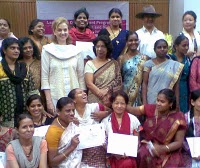 I am Manisha and I have been HIV+ for the last 8 years. I came to know of my status in 2002 when my husband fell sick. I had not known that he was HIV+. Even when he told me, I did not take it very seriously as I had no knowledge about this disease and took it as a common ailment like TB or malaria.…
This report analyzes why and how HIV/AIDS is now disproportionately affecting women, as individuals and in their roles as mothers and care-givers. It also explores new gender sensitive approaches to fighting HIV/AIDS and suggests that in order to be effective, it is necessary to deal with the inequality that both drive and are entrenched in the epidemic. The report discusses the meaning of a rights-based approach and addresses the evolution of…
The Action Framework (2009) was developed in response to the pressing need to address the persistent gender inequality and human rights violations that put women and girls at greater risk and vulnerability to HIV, and threaten the gains that have been made in preventing HIV transmission and increasing access to anti-retroviral treatment.